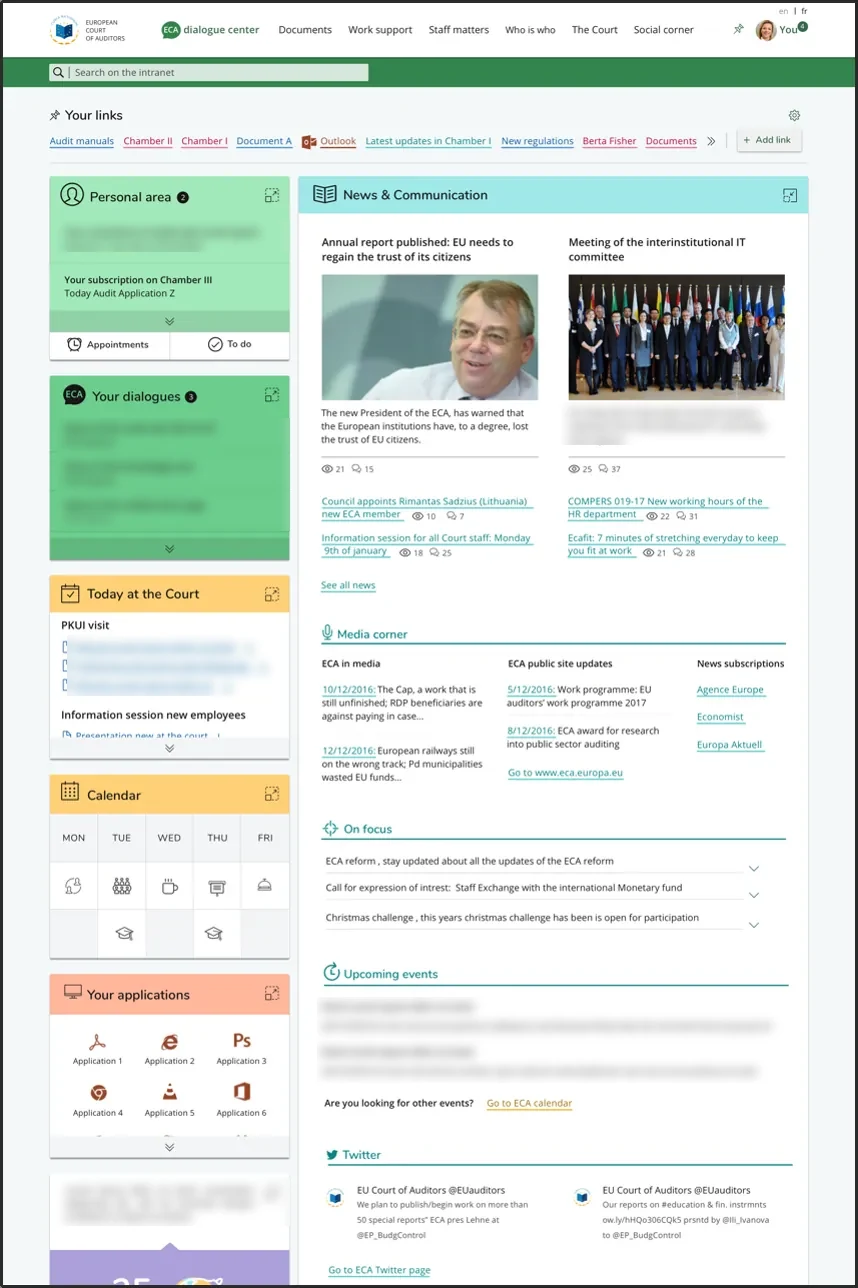
European Court of Auditors intranet
An outdated intranet that was not collaborative and not widely used had to become a central tool for how people work.
everis Brussels · 2015, six months
- My role
- Led the project
- Team
- 3 UX designers, 1 UX researcher
- Years
- 2015, six months
- Outcome
- A validated blueprint for the next phase
01 The full story
An intranet to impact the way we work, for the European Court of Auditors.
The brief
Redesign the ECA intranet to bring it up to current digital standards and make it a central tool for how people work.
The existing system was outdated, not collaborative, and not widely used. The objective was to transform it into a platform that supports communication, collaboration, and daily tasks across the organization.
My role
Led the project from early stakeholder alignment through delivery and next-step planning, helping shape both the direction of the work and how it was carried forward.
A key part of the role was keeping stakeholders engaged, building support across the process, and helping them champion a project that required changes in how teams worked.
- 09.A
A clear process and timeline
From the beginning, the project was set up with a clear process and timeline. Given the scale of the initiative, it was important to align everyone on what we were going to do, what we were not going to do, and how we would get there.
This created a shared understanding of priorities and expectations, and helped maintain focus throughout the project. It also introduced a sense of accountability not pressure in a negative way, but a clear commitment to delivering within the defined timeframe.
Regular communication was key. We made sure stakeholders always knew what was happening, what was coming next, and how they could contribute. This helped build trust in the process and ensured feedback was timely and relevant as we moved through each phase.
- 09.B
Building a strong connection with stakeholders to drive change
A key part of the project was building a strong connection with stakeholders to support the change.
We identified the main working groups within the organization and translated them into representative personas. These were not just documentation, but active participants in the process. They acted as a constant line of communication between the project team and the wider organization.
This approach helped ensure that the new intranet was seen as an opportunity rather than a disruption. By involving stakeholders throughout the process, we created a sense of ownership and made sure the solution reflected real needs and expectations.
- 09.C
A complex task simplified through clear journeys
A key challenge of the project was the complexity of the work carried out within the institution, and how to ensure the solution covered all relevant needs.
To address this, we worked with both macro and micro journeys. Macro journeys helped us understand the broader workflows across teams, while micro journeys allowed us to break down specific tasks and interactions in detail.
This approach ensured that the design decisions were grounded in real user needs and aligned with the tasks defined together with stakeholders. It helped us move from abstract requirements to concrete solutions that directly addressed identified pain points.
- 09.D
Lenticular design
Another key challenge was balancing ease of use with the level of expertise required for a daily professional tool. We approached this using lenticular design, making core tasks simple and accessible, while allowing additional complexity to appear progressively as users needed it.
This made navigation faster and more intuitive, improved readability across the intranet, and ensured that users could quickly find what they needed. At the same time, it preserved the depth required for more complex tasks, allowing the intranet to function as a reliable and effective work companion.
02 Ownership
What I did, and what the team did.
The design
Core tasks simple, more when you need it.
Lenticular design: the intranet shows the core tasks first, and more complexity appears progressively as people need it. It was grounded in five macro journeys, broad workflows across teams, and micro journeys for specific tasks.
- Searching for documents
- Searching for people
- Getting employee support
- Getting work support
- Being updated
03 Decision map
The decisions, and why.The pivotal decision.
Four decisions I made in this work, and how or why I made each one. Where a figure shows the result, it is linked.
-
01
ChoseA clear process and timeline from day oneHow
Regular communication with stakeholders throughout.
WhySo stakeholders always knew what was next.
See Fig. 9.1 ↓ -
02
ChoseTurn working groups into personas that took partWhy
Representative personas acted as a constant line of communication with the wider organisation.
See Fig. 9.2 ↓ -
03
ChoseMacro and micro journeysHow
Broad workflows across teams, and specific tasks in detail.
WhyTo ground design decisions in real needs.
See Fig. 9.3 ↓ -
04
ChoseLenticular design
04 Evidence
The work behind the decisions.
Select a figure to open it larger.
Supports decision 1 ↑
Supports decision 2 ↑
Supports decision 3 ↑
Supports decision 4 ↑
A validated direction that leadership and the working groups backed as the blueprint for the intranet’s next phase, reframed from publishing toward collaboration.
A validated direction that leadership and the working groups backed as the blueprint for the intranet's next phase.
The work reframed the intranet around how people actually work, shifting it from a publishing tool toward genuine collaboration, and set a clear, user-grounded foundation.
By taking a structured approach, maintaining constant communication with stakeholders, and ensuring that real user needs and tasks were consistently represented, we shaped a direction that turned real complexity into clarity.
Contact
Open to design leadership roles.
I’m based in Singapore and can work in Singapore and the EU without sponsorship. Available now.